

Table of Contents
Introduction
Agentic AI is a new class of digital coworkers that can understand goals, reason across multiple steps, and take actions across systems such as raising tickets, updating records, and orchestrating workflows, rather than just suggesting or informing.
This shift addresses a critical failure point in current operations. As McKinsey’s November 2025 analysis warns, 95% of tech pilots currently get stuck in “pilot purgatory” because they are designed as isolated experiments rather than systemic workforce changes. In a labour market facing structural shortages, the “Agentic COO” moves beyond simply deploying software to designing a new organisational chart where digital agents pick up the slack.
This article is grounded in an AI-enabled analysis of 84 reports on agentic AI published in 2025, spanning strategy firms, cloud providers, industry analysts, and practitioner case studies. Across that evidence base, one message is consistent: where COOs lean in, agentic AI stops being a lab experiment and becomes a serious lever for throughput, resilience, and cost.
Cristina Nitulescu, Head of Digital Transformation and IT at Bayer Consumer Health, captures the operational inflection point:
“AI technology is evolving quickly. A year ago, very few people were talking about AI agents at the enterprise level. With agentic AI as a positive disruptive force for our industry, we have to rethink processes for people and AI consumption. Prioritising agentic AI is about setting ourselves up for the future.”
The question for operations leaders is therefore not “Should we try agents?” but “How do we redesign operations so people and agents work as one team?”
1. Where Operations Really Are with Agentic AI
Across large enterprises, AI is now mainstream, but agent deployment in operations is still early and uneven.
- Around 9 in 10 organisations report regular AI use in at least one business function.
- Roughly 6 in 10 are at least experimenting with AI agents; only about a quarter are scaling at least one agent system somewhere in the enterprise.
- In any single function, no more than about 1 in 10 organisations say they are truly scaling agents.
Operationally focused functions where agents are most visible today include:
- IT and service management: helping service desks triage and resolve tickets, routing incidents, automating routine requests.
- Knowledge management and internal support: research agents that find information fast, policy assistants that answer questions, internal Q&A.
- Manufacturing and logistics: predicting equipment failures before they happen, controlling quality, optimising delivery routes.
- Service operations and contact centres: assisting human agents during calls, enabling customers to self-serve, writing up call summaries automatically.
Case examples show the upside when operations are ambitious and execute effectively:
- Siemens uses AI-driven maintenance prediction to cut maintenance costs by 20% and increase uptime by 15%.
- DHL uses AI to plan routes and manage warehouses, reducing operational costs by 15% and improving delivery times by 20%.
- Walmart’s demand-forecasting agents reduce inventory costs by about 15% while improving product availability.
- In CPG (consumer packaged goods) back-office work, multi-agent teams have delivered up to 90% reductions in processing time.
At the same time, independent benchmarks show that current agents are capable but unreliable on complex workflows: success rates can be around 70% for simple multi-step tasks but fall to around one-third for complex routing work, with “works perfectly every time” still out of reach.
For a COO, the picture is: huge upside, but only if operations are deliberately designed for mixed human and agent work, not blind autonomy.
2. What Top-Performing Operations Leaders Did Differently
The same patterns that distinguish AI high performers at enterprise level also show up in operations.
Transformational, not incremental, goals
In the high-performing organisations:
- Operations leaders are part of programmes that fundamentally redesign how work flows around AI and agents, not just add tools to existing processes.
- They rethink entire journeys such as incident-to-resolution, claim-to-cash, and order-to-delivery, rather than automating a single step in isolation.
Real-world programmes that achieved measurable ROI embedded agents across the entire workflow with clear business outcomes and governance, instead of automating one task in one location.
Treating agents as long-term capabilities, not projects
Successful COOs treat agentic AI as a long-term operational capability, not a one-off initiative:
- They define ownership and clear success measures for each agent, including business impact, how much autonomy it should have, accuracy, safety, how well it adapts to new situations, flexibility, ability to scale, adoption by staff and trust from users.
- They invest in watching how agents work and evaluating them step by step, building the ability to debug workflows at each stage rather than just checking the final result.
- They plan for continuous improvement, anticipating new data, new tools and new problems, and they build monitoring systems specifically for agents.
In practice, this looks less like “we rolled out an AI assistant” and more like “we now run a team that includes digital workers, and we monitor, coach and improve them just like human team members.”
3. Strategic Technology Choices: RPA, LLMs, Single Agents, Multi-Agent Teams
A key operational decision is not “agents or no agents?” but “which type of automation fits this process?”
Research from multiple sources align on how to choose the right approach. Here’s a useful reference for COOs when working with IT leaders to decide what type of automation makes sense for different work.
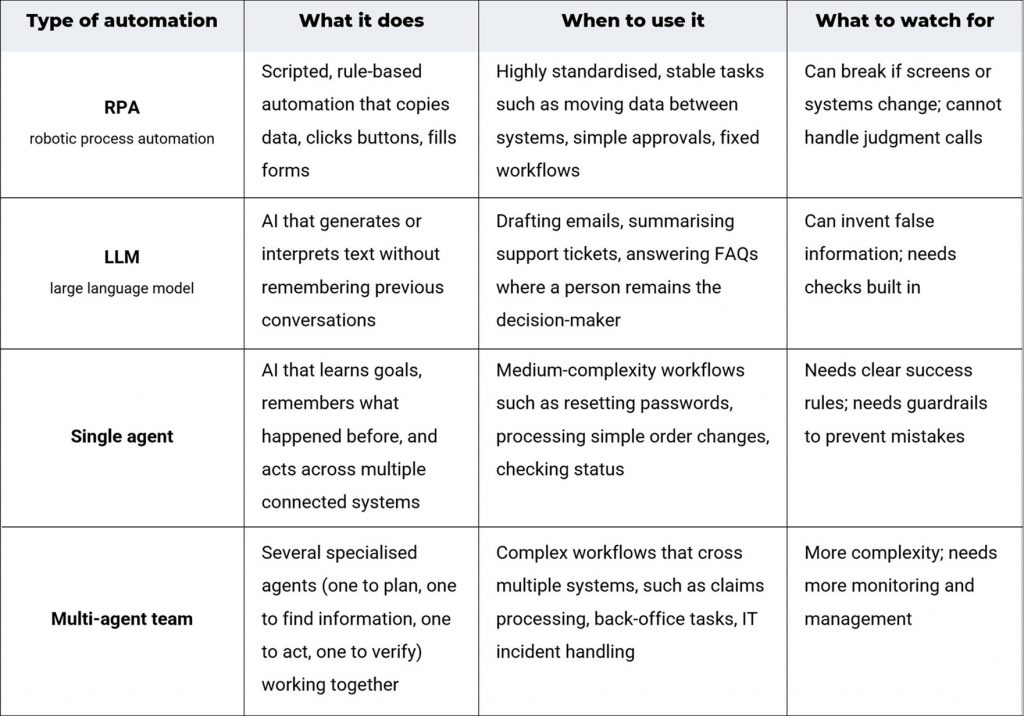
Here’s a simple operational rule of thumb on how to make the right choice:
- If the task is the same every time and rule-based, use RPA and make sure your connections between systems are clear.
- If the task is flexible but a person still makes the final call, add an AI helper or simple copilot.
- If the task involves multiple systems, decisions and unusual situations, design a single or team of agents, with people involved at important checkpoints.
4. Execution Patterns and Benchmarks: Designing Robust Digital Workflows
“It’s not about the agent; it’s about the workflow”
Practical deployment lessons consistently point to the same conclusion: focusing on how the work actually flows beats building a clever agent and hoping it works.
Organisations that build impressive agents without redesigning how work moves end up with impressive demos that do not actually change operational results.
High-performing operations have learnt these habits:
- Start from mapping the work and finding the pain points: where do people waste time, where do errors pile up, where does work get stuck between teams?
- Use the right mix of tools at each step:
- Rule-based automation for straightforward checks and updates
- Data analysis for scoring and prioritisation
- AI helpers for summarising, drafting and explanation
- Agents for managing work across connected systems and decision points
- Create instruction manuals for agents just as you would for new staff, including what they are responsible for, where they must stop and ask for help, when and how to escalate, what success looks like and what data they need to learn from.
Benchmarks that matter to COOs
Independent benchmarks provide real numbers on what agents can do right now:
- On simple human resources workflows such as processing time-off requests, best-case agent setups get about 7 in 10 scenarios right.
- On complex workflows such as intelligently routing customer requests to the right team, even the best setups succeed only about one-third of the time.
- When you require agents to work correctly across multiple repeated tries, reliability drops sharply into single digits.
A separate body of research suggests measuring agent success across nine dimensions: business impact, cost and speed, how much autonomy they have, accuracy, safety, ability to adapt to new situations, flexibility, ability to grow, and how much staff trust and use them.
Together, these findings point to one conclusion for COOs: build for people supervising agents, not for agents running alone. Design workflows so agents can:
- Suggest actions and handle simple tasks by themselves.
- Hand over complex, unusual or risky cases to people straight away.
- Be watched, measured and improved just like any other production system.
5. People, Trust and Change in Operations
Agentic AI changes what front-line staff, team leaders and ops managers do every day. From doing tasks to supervising agents and handling exceptions
Research on how workers feel about automation shows a consistent pattern:
- Workers welcome agents that do repetitive, boring, stressful tasks, especially when it frees up time for more interesting work; this is the most common reason people want automation.
- Across many job types, workers prefer working as equal partners with AI, not full automation of their role and not just tiny bits of help.
- AI appears to put pressure on entry-level, routine information-processing jobs first, while making relationship skills, coordination skills and coaching more valuable.
For operations, that means:
- Front-line teams move from “doing everything by hand” to supervising agents, handling unusual cases, managing exceptions, and providing empathy and judgment where agents cannot.
- New roles emerge: agent supervisors, monitoring engineers and AI collaboration coaches embedded in day-to-day operations.
- Change management matters as much as technology; staff resistance, not tech problems, is often the real barrier to getting agents deployed.
Velit Dundar, VP of Global eCommerce at Radisson Hotel Group, describes the opportunity from an operator’s view:
“For humans, time is invaluable. AI can multiply what people can accomplish and save that time. We are entering an era where humans and machines will work together as true partners.”
The change agenda for COOs is to make that partnership real in daily work, not just in planning documents.
6. A 12–18 Month COO Roadmap
To move from testing agents to running them as part of everyday operations, COOs can follow a staged roadmap.
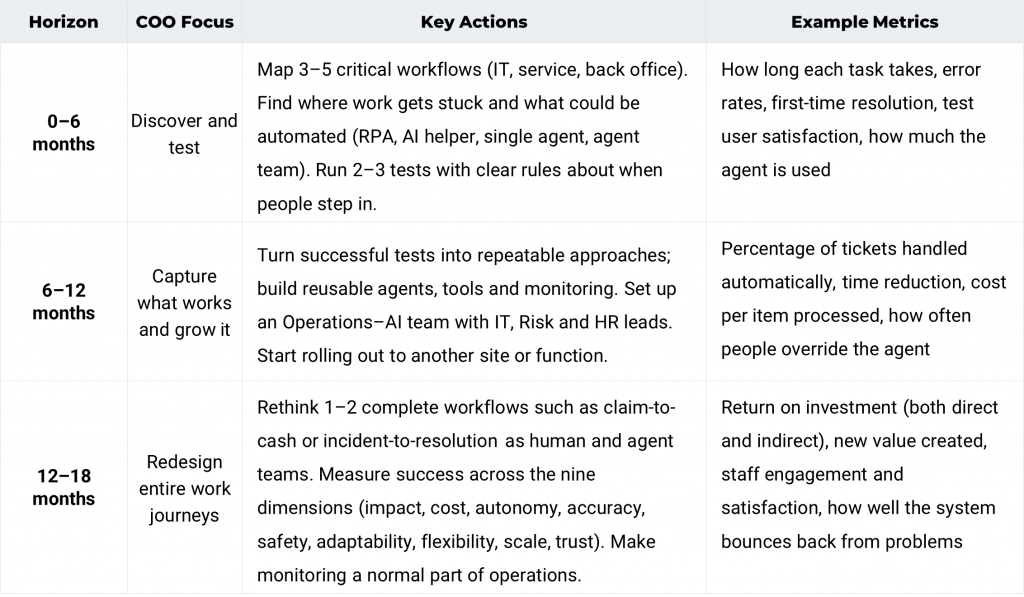
TIP: This roadmap should be framed explicitly as “building a digital workforce”, not “rolling out another tool.” That message matters for getting budget, support and the right people involved.
7. Closing: The COO as Chief Coordinator of Hybrid Work
For operations, agentic AI is not a distant possibility; it is already quietly improving maintenance work, IT support, contact centres, supply chains and back-office processing in leading organisations.
The analysis makes one thing clear: technology is no longer what is holding us back. The real factors are:
- Whether COOs are willing to treat agents as part of the team, with clear instructions, success measures, supervision and ongoing improvement.
- Whether they can pick the right tool for each type of work instead of trying to use agents for everything.
- Whether they build the data connections and monitoring systems that make agents safe and useful.
- Whether they lead the people side including skills, new roles and trust, so that agents are seen as helpers, not threats.
Done well, agentic AI lets operations move from firefighting and small savings to designing a resilient, learning, always-available digital workforce that improves every day. The COO’s role is to lead that shift, turning agents from an interesting experiment into a core part of how the organisation actually runs.
8. Bonus Idea: Know Where You Are On The Map
The progress across this year has been astonishing. Even more so, when we remember that top tier vendors only started to seriously promote agentic AI at their annual conferences late ’24 early ’25.
Even so it’s important to keep in mind this fundamental dynamic.
While agentic technology continues at pace, organisational readiness remains the drag on momentum. This is likely to remain so in the years ahead.
The reason is simply that the agentic path turns much steeper here on in.
Agentic evolution from where most are now (workflow orientated use cases) to increasingly autonomous stages of decision making and execution demand fundamental transformation in organisational design. Analogous to the redesign of work from pre to post-industrial revolution.

This is a journey that requires courage and imagination with humility enough to learn what already works.
It’s why Brainfood is focused on delivering such insights, distilled from the widest possible base of research. Ready to be applied within organisations for evidence-based decision making with assurance they are grounded in what is known to work. A fast track to increase your odds of success.
It is also why we use the same base of research to update Brainfood’s readiness assessments which are designed to audit any organisation’s full spectrum of readiness as they transition through the stages of agentic capability.
For any COO, knowing where to focus is as important as the ability to execute.
